
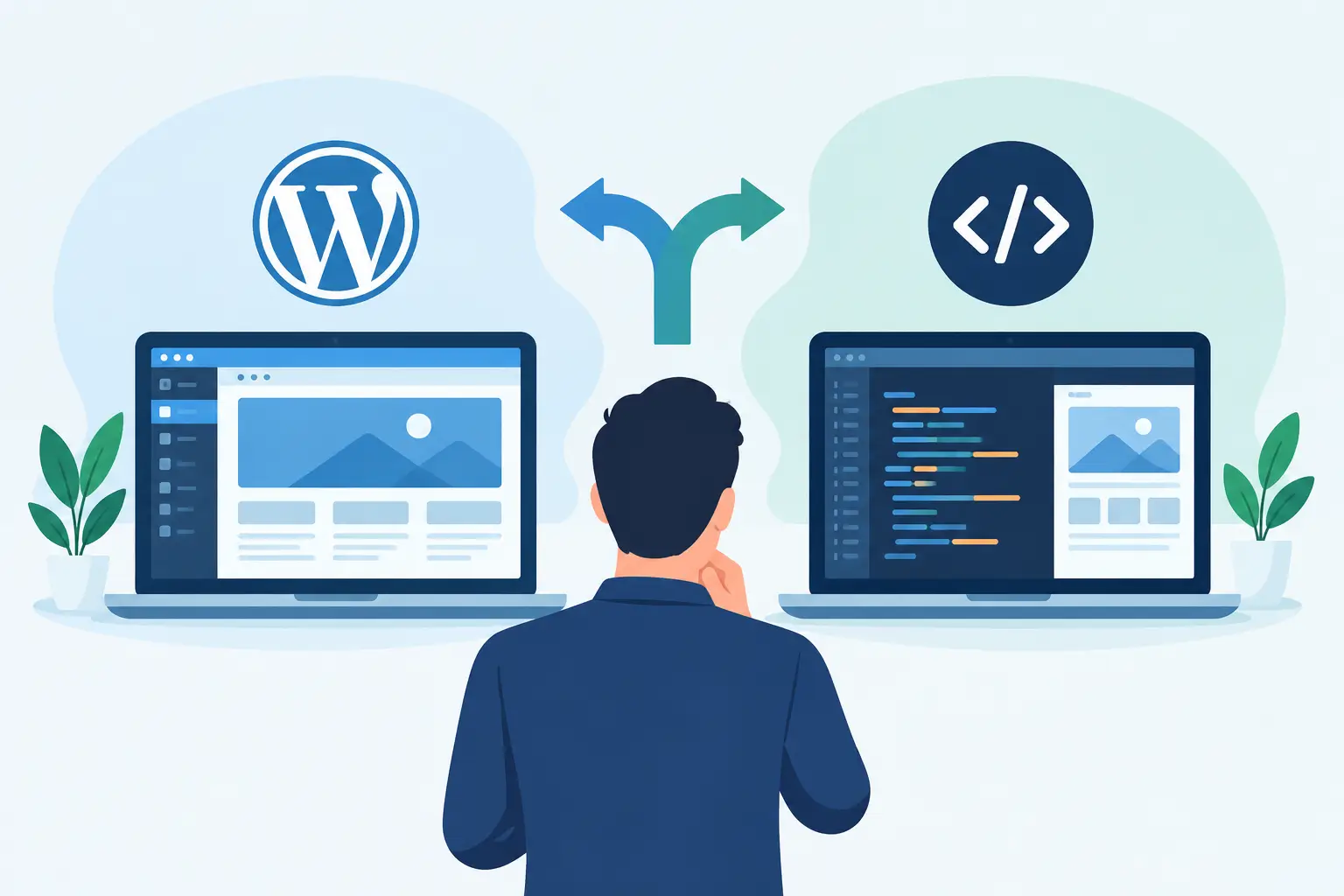
A website that launches quickly but cannot support your next sales process, customer portal, or integration becomes an expensive shortcut. The WordPress versus custom website decision is not really about choosing a popular platform over bespoke code. It is about choosing the level of investment, control, and operational capability your business needs now and in the next stage of growth.
For a startup or growing business, either route can be the right one. The costly mistake is treating the decision as purely visual, or assuming custom development is automatically more sophisticated. The best choice starts with the business outcome: what the site must do, who needs to manage it, how quickly it needs to launch, and what a successful result is worth.
Start with the job the website must do
A marketing website, a lead-generation engine, a resource center, and a customer-facing product may all be called "a website," but they place very different demands on technology.
WordPress is typically a strong fit when your priority is publishing and managing content without relying on developers for every update. It is proven, widely understood, and can support polished brand experiences, landing pages, blogs, forms, basic ecommerce, and integrations with mainstream marketing tools. With an experienced implementation, WordPress does not have to look templated or perform poorly.
A custom website is a better description for a purpose-built digital experience. It may use a custom frontend, a headless content management system, a tailored backend, or integrations designed around your existing systems. It is appropriate when the website needs to behave more like software: personalized user journeys, complex workflows, account-based experiences, proprietary calculators, secure portals, marketplace features, or deeply connected operational data.
The distinction matters because a content-led site and a workflow-led product should not be planned or budgeted in the same way.
WordPress versus custom website: the practical trade-offs
Speed is often the clearest difference. A WordPress site can move from strategy and design into launch quickly because the content management foundation already exists. Teams can focus their budget on information architecture, messaging, design, conversion paths, and the specific functionality that creates value. For an early-stage company validating its positioning or preparing for a fundraising milestone, that speed can be decisive.
Custom development requires more upfront decisions. Your team needs to define user roles, data models, integrations, exceptions, administration requirements, and future use cases. That discovery is not unnecessary overhead. It is how you avoid building a polished interface around an unclear business process. Still, it adds time and cost before launch.
Flexibility follows the opposite pattern. WordPress can be extended significantly, but its structure, plugin ecosystem, and update cycle set practical boundaries. If each new requirement depends on another plugin or a workaround, the site can become difficult to maintain. Custom development gives you more freedom to shape the system around the business, provided the requirements are disciplined and the architecture is designed for change.
Cost should be evaluated beyond the initial build. A lower launch cost is valuable only if the site remains secure, fast, and manageable. A custom build may cost more initially but reduce manual work, improve conversion, connect disconnected systems, or create a differentiated customer experience. Those gains can justify the investment. Conversely, building custom functionality for a brochure site can tie up capital that would produce better returns in marketing, sales, or product development.
Do not confuse design quality with platform choice
A common assumption is that WordPress produces generic websites while custom development produces premium ones. Neither is true.
Design quality comes from a clear brand strategy, strong content hierarchy, thoughtful interaction design, and rigorous implementation. A well-designed WordPress site can feel distinctive, load quickly, and guide visitors to the right action. A custom website can still underperform if the message is vague, the navigation is confusing, or the conversion flow is poorly designed.
The same applies to search performance. WordPress offers mature tools for content publishing and on-page SEO, which can be an advantage for teams producing regular articles, case studies, and landing pages. But rankings depend on useful content, technical hygiene, site performance, and authority, not on a CMS badge. A custom site can perform exceptionally well in search when it is built with those fundamentals from the start.
Security, maintenance, and ownership deserve early attention
Every website needs maintenance. WordPress requires regular updates to its core software, themes, and plugins. The larger the plugin footprint, the more carefully those updates need to be tested. Reputable plugins and a disciplined maintenance process can manage this well, but neglect is what creates risk.
Custom software also requires maintenance, even if there are fewer public updates to install. Dependencies change, cloud services evolve, integrations break, and security practices need review. The real question is whether you have a clear owner, documentation, monitoring, backups, and a realistic support plan after launch.
For decision-makers, ownership is equally important. Ask who can update content, create new pages, review performance, and resolve an issue on a Friday afternoon. A technically elegant system that only one developer understands introduces business risk. A practical solution gives internal teams appropriate control while keeping complex changes governed.
When WordPress is usually the smarter investment
WordPress is often the right choice when the business needs a credible, conversion-focused digital presence on a disciplined timeline and budget. It works particularly well for professional services firms, B2B companies, content-driven brands, early-stage startups, and organizations modernizing an outdated marketing site.
It is also a sensible option when marketing needs to move independently. If your team will publish thought leadership, test campaign pages, update service offerings, and refine calls to action frequently, an approachable CMS is a commercial advantage. The goal is not to avoid engineering. It is to reserve engineering investment for the parts of the business where it creates genuine differentiation.
That said, a WordPress implementation should not be a collection of off-the-shelf components assembled without a plan. Define the content model, performance standards, analytics requirements, integration needs, and editorial workflow before selecting plugins. This keeps the platform useful rather than fragile.
When custom development earns its cost
A custom website earns its investment when the experience itself supports a meaningful business capability. That might mean reducing time spent by operations teams, making a complicated service easier to buy, giving customers self-service access, or connecting data that currently lives in disconnected tools.
Custom is also justified when constraints are becoming costly. Perhaps your sales team cannot qualify leads effectively because form data is incomplete. Maybe customers need different content based on account status, location, or product usage. Or your business has built an internal process that works but cannot scale through spreadsheets and email. These are signals that the project may be moving beyond a conventional marketing website.
The strongest custom projects begin with a narrow, valuable problem rather than an ambition to build everything at once. Define the first workflow, measure the result, and create an architecture that can grow without forcing a large speculative build.
Use a decision framework, not a platform preference
Before committing, align leadership, marketing, and technical stakeholders around four questions:
- What business result must this website produce within the next 6 to 12 months?
- What actions should visitors, customers, or internal teams be able to complete?
- Which systems must exchange data with the site, now or soon?
- What will it cost if the site cannot adapt when the business changes?
If the answers center on content, lead generation, speed, and straightforward integrations, WordPress is likely the efficient path. If they center on proprietary workflows, complex data, user accounts, automation, or strategic differentiation, custom development deserves serious consideration.
There is also a practical middle ground. Many businesses start with a high-quality WordPress marketing site while building a custom product or portal separately. Others use WordPress as a content management layer with a custom frontend. The right architecture can separate what marketers need to change often from what engineers need to control carefully.
A strategy-led discovery process helps make that call with evidence instead of assumptions. At Valuedriven, the aim is not to sell the largest build. It is to identify the smallest high-impact solution that supports growth today and does not block the next meaningful move.
Choose the platform that makes progress easier after launch. A website should give your team a clearer way to win attention, convert demand, serve customers, or run the business - not create another system that needs defending.