
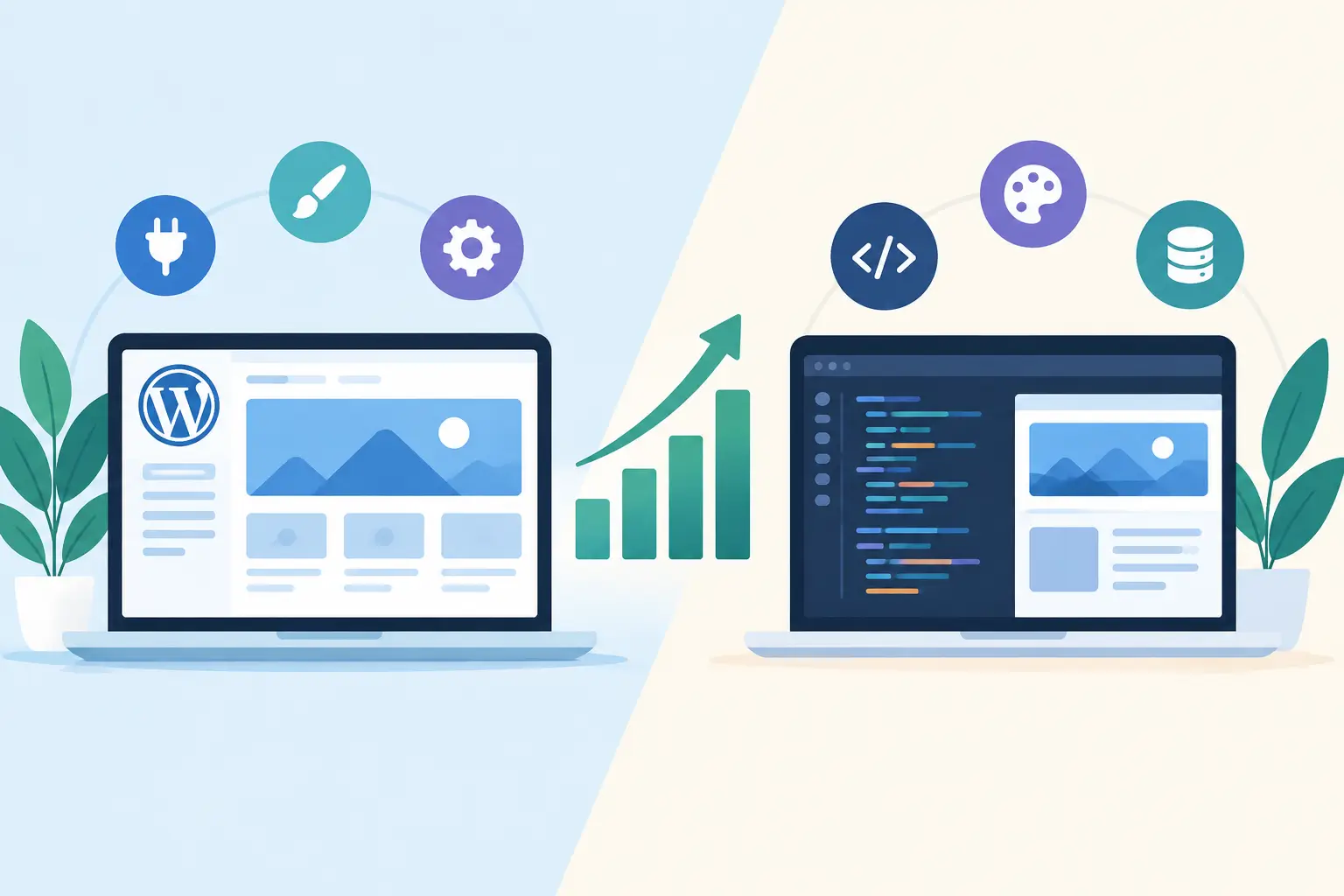
A website that takes six months to launch can miss the market. A website that launches in three weeks but cannot support your sales process, integrations, or content team can become just as expensive. The WordPress or custom website decision is not really about choosing a popular platform versus bespoke code. It is a decision about what your business needs to accomplish now, what must change next, and how much complexity is justified by the return.
For founders and SME leaders, the wrong choice often shows up later. Marketing cannot publish a campaign without developer help. Sales teams send prospects to generic pages that do not reflect the buying journey. Operations staff maintain customer data in spreadsheets because the website cannot connect to the systems they use every day. The goal is to avoid building either too little or too much.
WordPress or Custom Website: Start With the Business Case
WordPress is a content management system that can power anything from a simple marketing site to a sophisticated content-led business website. A custom website is designed and developed around specific requirements, which may include a custom content platform, a headless CMS, a web application, or proprietary workflows. These are not always opposing options. A tailored WordPress implementation can be the right answer, while a custom front end with a CMS can give a business both editorial flexibility and specialized functionality.
The useful question is not, “Which technology is better?” It is, “What capability will produce the next stage of growth?” A company generating demand through thought leadership, landing pages, case studies, and regular campaign updates needs speed in content operations. A company whose website is central to configuring products, onboarding users, quoting services, managing applications, or delivering a customer portal has a different set of priorities.
Start by identifying the website's job. Is it primarily a credibility and lead-generation asset? Is it an acquisition channel that needs frequent testing? Is it part of the product itself? Does it need to exchange information with a CRM, ERP, applicant tracking system, payment platform, or internal database? The answer determines the appropriate level of investment more reliably than a preference for a particular stack.
When WordPress Is the Commercially Sound Choice
WordPress is often a strong fit when the business needs a polished, high-performing marketing website on a focused timeline. It gives internal teams a familiar interface for publishing pages, articles, resource libraries, and campaign content without relying on engineering for every change. That autonomy can have real commercial value when marketing calendars move quickly.
It is particularly effective for businesses with clear information architecture and standard conversion paths. Think of a B2B services firm that needs capability pages, industry pages, case studies, insights, contact forms, and integrations with its CRM. A well-designed WordPress site can support this work without treating every new page as a development project.
The key qualification is well-designed. WordPress is not automatically fast, secure, or easy to maintain just because it is widely used. Problems usually come from installing too many plugins, using poorly maintained themes, accepting generic templates, or leaving ownership unclear after launch. A site that depends on a long chain of low-quality extensions may be inexpensive at the start and costly to stabilize later.
A disciplined WordPress build should use a custom design system, defined editing components, limited and vetted plugins, performance standards, and an update plan. It should also make clear who owns hosting, security monitoring, backups, accessibility improvements, and ongoing enhancements. Those operating decisions matter as much as the initial build.
WordPress also works well when uncertainty is high. If you are validating a new positioning, market segment, or service offer, a flexible marketing platform lets your team learn before committing to a larger product investment. In that situation, the fastest route to a credible, measurable launch may create more value than a highly customized platform.
When a Custom Website Earns Its Investment
Custom development becomes the stronger option when the website must do something materially different from publishing content and collecting leads. The more your commercial process depends on unique workflows, complex data, user roles, or tailored integrations, the less sensible it is to force the requirement into a general-purpose CMS.
For example, a manufacturer may need a product configurator that calculates compatible components and generates qualified quote requests. A staffing business may need a candidate experience connected to internal systems and governed by precise workflows. A B2B platform may need a secure customer area where users access documents, data, and account-specific actions. These are product capabilities, not simply website features.
Custom builds can also improve performance and maintainability when a business has specific requirements. Rather than adapting a theme and multiple plugins to fit a complicated use case, the team can create only what is necessary. That can reduce technical friction, improve user experience, and give the organization greater control over future changes.
But custom does not automatically mean better. It requires clearer product decisions, more upfront planning, and a realistic commitment to maintenance. Every custom feature becomes something your business owns. If requirements are vague or the feature does not support a measurable business outcome, custom development can turn into expensive speculation.
The case for a custom website is strongest when it removes a costly manual process, creates a differentiated customer experience, supports revenue operations, or forms the foundation for a digital product. If the investment cannot be connected to one of those outcomes, a simpler approach may be more responsible.
Compare Total Cost, Not Just Launch Cost
A WordPress site generally has a lower initial cost because the core platform and publishing model already exist. A custom site usually requires more design, architecture, development, testing, and documentation before launch. That difference is real, but it is only one part of the financial picture.
The total cost of ownership includes updates, hosting, security, licenses, support, internal training, performance work, future integrations, and the cost of slow change. A low-cost site that makes every campaign update difficult can create hidden operational expense. A highly customized platform that only a specialist developer understands can create risk when the business needs to move quickly.
Consider the cost of delay as well. If a new website must support an upcoming fundraise, product launch, market expansion, or sales initiative, a solution that is technically ambitious but late may be the wrong business decision. On the other hand, rushing a core customer workflow into a template can lead to rework just when demand starts to grow.
A useful planning exercise is to look 18 to 24 months ahead. Estimate the changes you expect: new service lines, more content, new integrations, customer self-service, additional markets, or higher traffic. Then separate those needs into two groups: capabilities required for launch and capabilities that can wait until evidence justifies them. This helps protect budget discipline without blocking a scalable path.
A Practical Decision Framework
Choose WordPress when content velocity, marketing independence, and speed to launch are the primary needs. It is usually the right foundation for a business website where the customer journey is understood, content will change regularly, and standard integrations can support the sales process.
Choose custom development when the website is a core operational or product asset. If your advantage depends on a specialized workflow, sophisticated data handling, account-based experiences, or integrations that directly shape delivery and revenue, custom architecture deserves serious consideration.
Consider a hybrid approach when you need both editorial speed and tailored functionality. A custom front end or application can handle the experience that differentiates your business, while a structured CMS allows nontechnical teams to manage content. This approach requires thoughtful architecture, but it can prevent the false choice between marketer autonomy and engineering control.
Whichever direction you take, define success before design begins. Metrics might include qualified leads, demo conversion, time to publish a campaign, application completion rate, customer support deflection, or revenue influenced by digital channels. A website project becomes easier to prioritize when the team can explain what will improve, who benefits, and how the result will be measured.
Build for the Next Decision, Not Every Future Possibility
Many teams overbuild because they are trying to solve for every imagined future. Others underbuild because they focus only on launch. The better approach is to make a deliberate first investment that supports the next meaningful business decision.
That may mean launching a focused WordPress site that tests messaging and generates qualified demand before building a customer platform. It may mean investing in a custom workflow because it eliminates a manual bottleneck that is already constraining growth. The right answer follows the evidence in your business, not a default technology preference.
Before committing, map the user journeys, internal processes, integration needs, ownership model, and expected changes over the next two years. A clear roadmap will reveal whether you need a capable publishing platform, a custom digital product, or a phased combination of both. That clarity is what turns a website budget into a growth investment.