
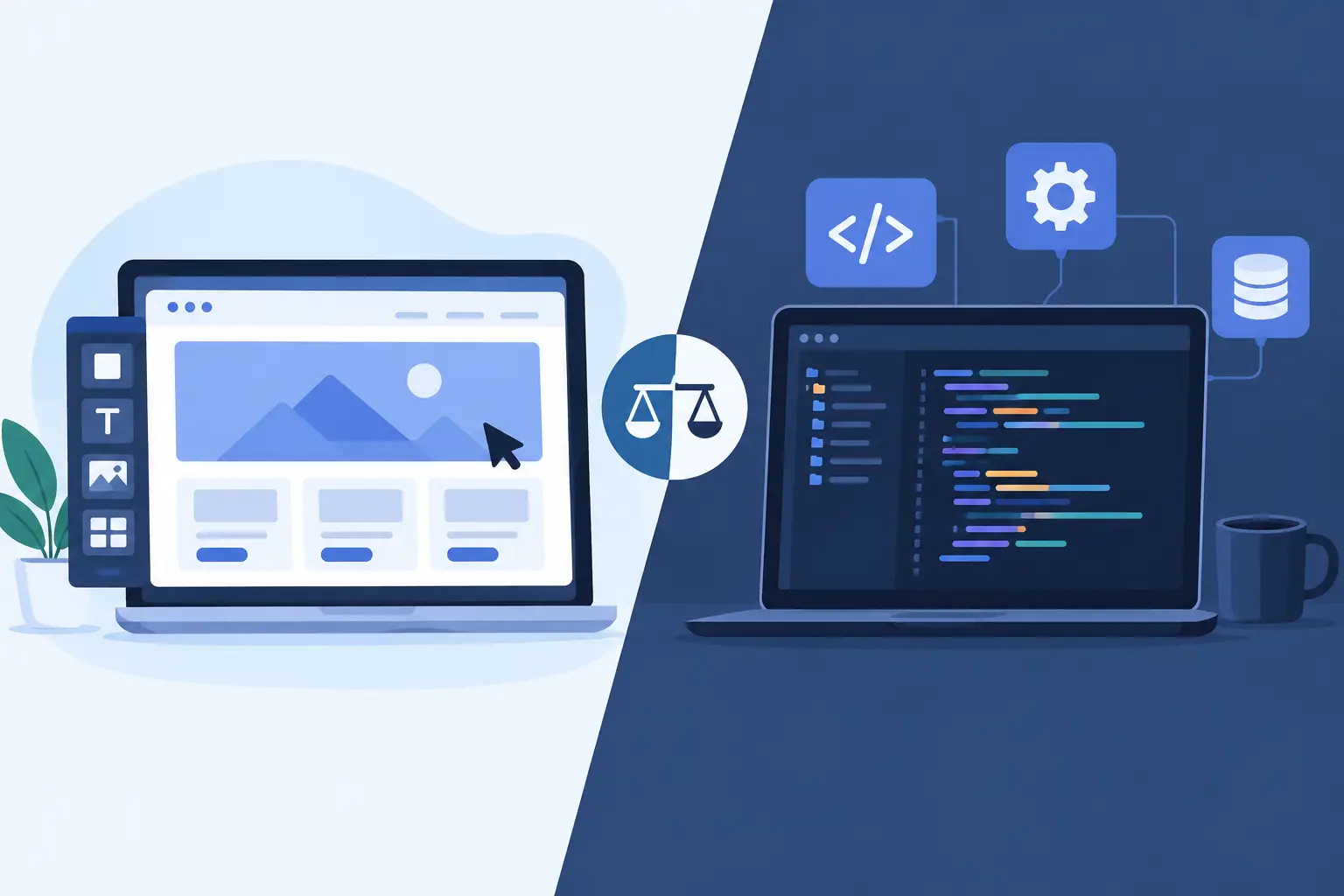
A marketing site that takes six months to launch is rarely a technical success. A beautifully designed Webflow site that cannot support your lead routing, customer portal, or growth plan is not a business success either. The Webflow versus custom development decision is not about choosing the more sophisticated option. It is about choosing the smallest, smartest investment that can achieve the outcome you need now without creating an expensive constraint later.
For founders and SME leaders, that distinction matters. The wrong choice can tie up budget in engineering before demand is proven, or it can leave a growing team rebuilding critical systems just as momentum picks up. The right choice creates a clear path from launch to measurable business value.
Start With the Business Job, Not the Technology
Webflow and custom development solve different problems well. Webflow is a visual development platform built for teams that need high-quality, content-rich websites quickly. Custom development is the deliberate design and engineering of a website, application, or platform around specific requirements, integrations, and workflows.
The first question is not, “Which is better?” Ask what the digital experience must do for the business over the next 12 to 18 months.
If the goal is to launch a new brand, validate positioning, publish thought leadership, improve conversion on service pages, or give marketing ownership of content updates, Webflow can be a strong fit. It reduces the gap between approved design and a live site, while making routine page and content changes far less dependent on developers.
If the experience must authenticate users, manage complex permissions, calculate prices, connect to internal systems, process sensitive data, or provide a differentiated product capability, custom development is usually the better foundation. Those needs are not simply “more pages.” They are software requirements with long-term operational consequences.
A common mistake is treating a website and a web product as the same category. They can share a domain and visual identity, but they should not automatically share the same technical approach.
Where Webflow Delivers the Most Value
Webflow is often the right answer when speed, design quality, and marketing autonomy matter more than deeply customized functionality. A focused team can move from strategy and design to a polished production site in weeks rather than months, provided decisions are made quickly and the scope stays disciplined.
That speed has commercial value. A startup preparing for fundraising may need a credible market presence before investor conversations begin. A services business may need landing pages to test a new offer before committing to a larger go-to-market campaign. An HR team may need a stronger employer brand site ahead of a hiring push. In these cases, a custom codebase can be unnecessary overhead.
Webflow also helps avoid a familiar bottleneck: every small content change becoming a development ticket. With a well-structured content management system, a marketing team can publish case studies, update team pages, adjust campaign copy, and create new landing pages without waiting in an engineering queue.
The platform works especially well for brochure sites, editorial content, campaign pages, portfolios, early-stage company websites, and conversion-focused marketing experiences. It can also support integrations with common form, analytics, CRM, and automation tools when requirements are straightforward.
However, Webflow’s strengths depend on good implementation. A rushed build with inconsistent styles, poorly modeled content collections, and ungoverned third-party scripts can become difficult to maintain. The tool may be visual, but it still benefits from technical standards, component discipline, performance oversight, and clear ownership.
Where Custom Development Earns Its Cost
Custom development is justified when the website or platform is part of how the business operates, not just how it presents itself. It gives you control over application logic, data models, integrations, performance priorities, user roles, and the customer experience beyond a standard content site.
Consider a B2B company that needs a customer portal with account-specific documents, approval workflows, usage reporting, and role-based access. Or a marketplace that needs vendor onboarding, inventory synchronization, payments, and operational dashboards. These are business systems. Trying to force them into a site builder can create fragile workarounds that cost more than building the right foundation.
Custom development is also the stronger choice when a digital experience needs to become a defensible capability. If your product’s advantage depends on a specialized workflow, proprietary data, AI-assisted functionality, or an unusually efficient customer journey, control matters. A generic implementation can make it harder to evolve the product as you learn from users.
The trade-off is real. Custom projects require more discovery, stronger product decisions, deeper quality assurance, and an ongoing plan for maintenance. They also demand discipline from the business. If priorities are still changing weekly, building every possibility into a custom platform is a fast way to spend budget without gaining clarity.
Custom does not mean building everything from scratch. Strong engineering teams use proven frameworks, managed infrastructure, APIs, and reusable components where they make sense. The goal is not maximum code. The goal is a maintainable solution that supports the business model.
Webflow Versus Custom Development: Compare the Real Trade-Offs
The most useful comparison is not feature by feature. It is a comparison of constraints.
Time to market
Webflow usually wins for a defined marketing website. The visual workflow, hosting model, and content tools reduce implementation time. Custom development takes longer because more decisions must be designed, built, tested, and maintained.
But speed changes when requirements are complex. Building several workarounds for user accounts, bespoke data, and multi-system workflows in a visual platform can be slower than building a targeted custom solution from the start.
Upfront and ongoing cost
Webflow generally has a lower initial cost for standard sites, particularly when the team can use existing design patterns and a clear content model. It may also lower day-to-day marketing costs by enabling nontechnical updates.
Custom development requires a larger upfront investment. Yet it can have a better total cost of ownership when it eliminates manual work, reduces integration errors, supports revenue-generating features, or prevents repeated platform migrations. The relevant question is not which option is cheaper at launch. It is which option produces a stronger return over the period you plan to use it.
Flexibility and control
Custom development offers more freedom, but freedom is only valuable when it supports a real requirement. You can tailor behavior, architecture, security controls, data handling, and integrations to the organization. You also assume responsibility for those choices.
Webflow offers enough flexibility for many marketing needs, but it operates within platform boundaries. Those boundaries are often beneficial because they prevent unnecessary complexity. They become limiting when the business needs capabilities the platform was not designed to own.
Team ownership
A Webflow site can empower marketers and content teams when it is thoughtfully configured. That can be a significant advantage for organizations that cannot justify a full-time web developer for routine updates.
A custom platform typically needs technical ownership, whether that comes from an internal team, an embedded partner, or a reliable support arrangement. If there is no plan to maintain it, custom development can become a liability regardless of how well it is built.
A Practical Decision Framework
Before selecting a platform, define the primary job of the experience in one sentence. For example: “Generate qualified demo requests from mid-market operations leaders,” or “Allow existing customers to manage account documents without support intervention.” This prevents a technology discussion from becoming a preference debate.
Next, separate launch requirements from future ideas. A credible roadmap matters, but building phase-three functionality into phase one often delays learning. Identify what must be true on launch day, what can be handled through a temporary process, and what becomes necessary only after traction is proven.
Then assess the cost of being wrong. If a site needs to evolve frequently as messaging changes, Webflow may reduce risk because changes are fast and inexpensive. If incorrect data, failed transactions, or access-control issues could affect customers or compliance, invest in the engineering rigor of a custom solution.
Finally, consider the transition path. A Webflow marketing site and a custom application can coexist. Many growing businesses use Webflow for public-facing content and campaigns while developing their core product separately. This hybrid approach lets marketing move quickly without compromising the architecture of the product itself.
Avoid the False Either-Or Decision
The best implementation is often phased. Start with the smallest credible experience that can test demand, establish the brand, or improve conversion. Use what you learn to determine where custom investment will create measurable leverage.
That may mean launching in Webflow, then building a custom portal when self-service usage reaches a meaningful threshold. It may mean creating a custom product first, while keeping the marketing site in Webflow so the growth team can move independently. The sequence should follow business risk, not technical fashion.
At Valuedriven, the starting point is the same regardless of platform: clarify the business objective, define the operating constraints, and select the approach that protects speed without sacrificing the next stage of growth.
Choose Webflow when it accelerates learning and gives your team room to execute. Choose custom development when the experience itself must carry operational, revenue, or product responsibility. The useful decision is the one that gets your business to its next proof point with confidence, not the one that sounds most impressive in a planning meeting.