
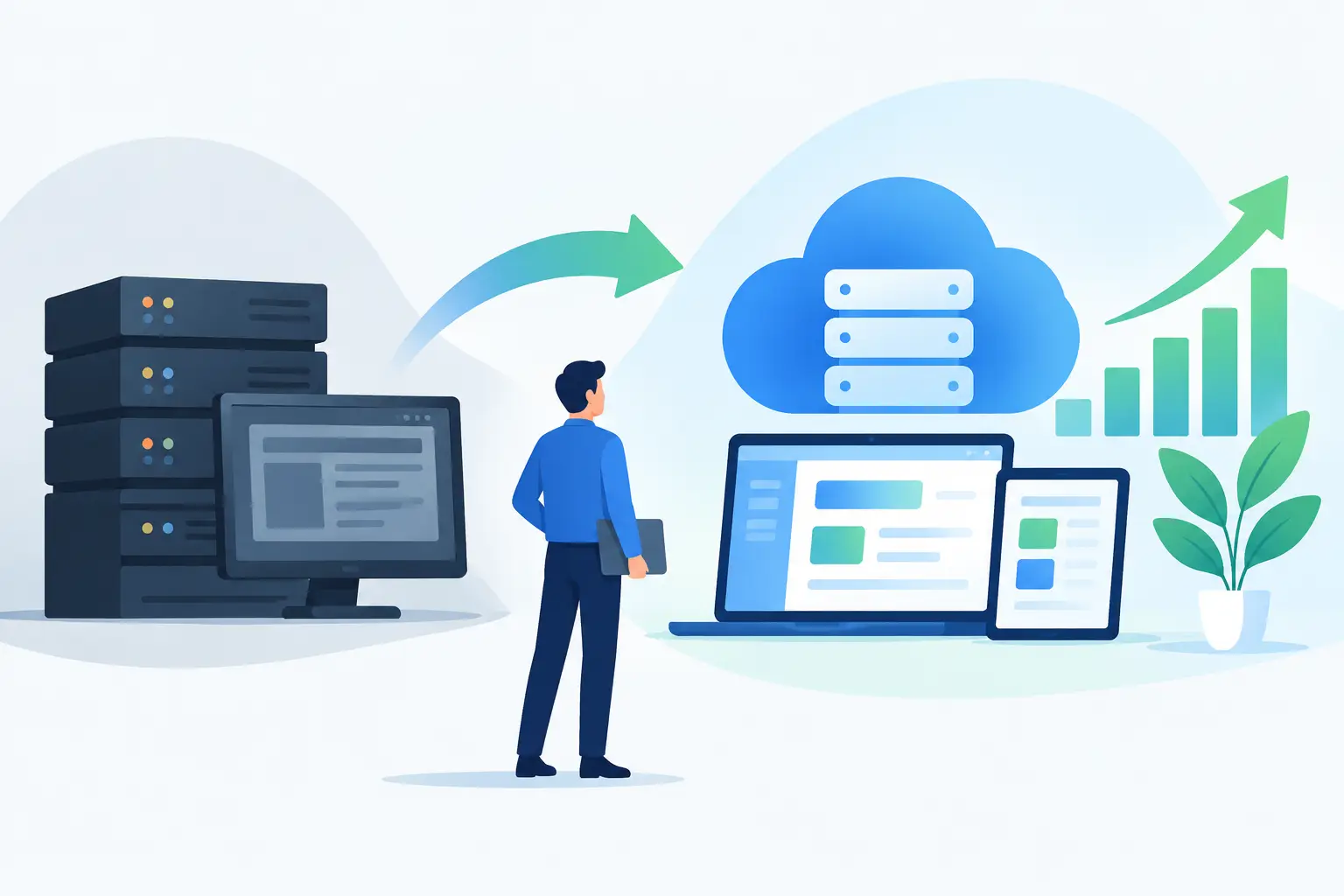
A legacy platform rarely fails all at once. More often, it creates small but expensive problems: releases take longer, manual workarounds multiply, customer experiences feel dated, and the team becomes reluctant to touch critical parts of the system. By the time a company labels this a technical problem, it has often become a growth problem.
Software modernization is the disciplined process of improving an existing application, platform, or technology foundation so it can support current business priorities. For founders and SME leaders, the goal is not to replace old code for its own sake. The goal is to reduce friction, improve decision-making, protect revenue, and create a platform that can keep up with the business.
Software modernization starts with business value
Modernization initiatives can easily become open-ended engineering programs. Teams identify aging frameworks, infrastructure gaps, and years of accumulated technical debt, then propose a major rebuild. Some rebuilds are necessary. Many are not.
The better starting point is a business question: what is the current system preventing the company from doing? Perhaps sales teams cannot access reliable customer data. Perhaps new features take months instead of weeks. Perhaps customers abandon a workflow designed around assumptions from five years ago. Perhaps the platform cannot support an AI capability that has become central to the product roadmap.
Those constraints create the case for change. Technology choices should follow from the outcome, not lead it.
A useful modernization strategy connects each proposed investment to a measurable result. That may mean lowering support volume, improving conversion, reducing time spent on manual operations, increasing deployment frequency, or creating a faster path to test a new market. When the expected result is unclear, the work is likely too broad or insufficiently prioritized.
The hidden cost of keeping systems as they are
Older software is not automatically bad software. A stable system that performs its core job well may deserve targeted maintenance rather than major intervention. The problem arises when maintenance consumes capacity that should be funding growth.
The cost often shows up in areas leaders can already see. Engineers spend too much time resolving production issues. Operations teams export spreadsheets because systems do not connect. Product ideas are delayed because a simple change has unpredictable side effects. Security or compliance updates become stressful because no one is confident about dependencies or access controls.
There is also an opportunity cost. A company may be unable to introduce self-service onboarding, integrate with a strategic partner, personalize customer communications, or use AI responsibly because the data and workflows underneath are fragmented. Competitors do not need a better technology stack in the abstract. They only need to respond faster to customer needs.
That is why modernization should be treated as a business capability. It improves the organization’s ability to make and deliver decisions, not just the quality of its codebase.
Choose the right modernization path
There is no single approach that fits every platform. The right path depends on the software’s condition, the urgency of the business need, the risk of disruption, and the budget available. A practical assessment usually separates what must change now from what can be improved over time.
Improve what already works
In many cases, the fastest return comes from targeted improvements. A company may update a critical user flow, replace a fragile third-party integration, improve performance in a high-volume process, or move selected workloads to more manageable infrastructure.
This approach is effective when the core system remains sound but specific bottlenecks are limiting growth. It is also a strong option when leadership needs evidence before approving a broader investment. A focused initiative can produce measurable results while revealing the deeper constraints that should be addressed next.
Rebuild a high-value component
Sometimes the most valuable move is to replace one part of the platform without rewriting everything around it. For example, an outdated customer portal, reporting interface, scheduling workflow, or internal operations tool may be holding back the entire experience.
A component-level rebuild creates a cleaner foundation where it matters most. It can also be designed to integrate with existing systems during the transition. This reduces the risk of a big-bang launch while giving the business a meaningful upgrade sooner.
Replatform or rearchitect when the foundation is the constraint
A larger replatforming effort becomes justified when limitations are structural: the application cannot scale reliably, the architecture makes change prohibitively slow, security risks are material, or the system depends on unsupported technology.
This is the highest-risk option, but it may be the most responsible one when patching no longer addresses the underlying issue. The key is to avoid treating it as a purely technical replacement. A new platform should have a clear operating model, defined ownership, migration plan, and delivery milestones tied to business value.
Build a roadmap before committing to a rebuild
The strongest modernization programs begin with discovery that is short, focused, and decision-oriented. The purpose is not to document every line of code. It is to establish enough clarity to make sound investment choices.
Start by mapping the most important workflows from the customer and employee perspectives. Identify where delays, errors, rework, and drop-off occur. Then assess the systems, data sources, integrations, and manual processes supporting those workflows. This reveals whether the problem is a user experience issue, an architectural issue, a data issue, or a combination of all three.
Next, prioritize the opportunities using three practical questions: What is the business impact? What is the delivery risk? What is the smallest meaningful release? A modernization roadmap should make trade-offs visible. A high-value initiative that can ship in eight weeks may deserve priority over a technically appealing project with uncertain commercial benefit.
The roadmap should also define what will not be modernized yet. Scope discipline protects budget and momentum. Few growing companies need an enterprise-wide transformation program. They need a sequence of investments that creates value early and leaves the platform stronger after each release.
Avoid the common modernization traps
The first trap is the full rewrite reflex. Rebuilding can appear cleaner than improving a messy existing system, but it introduces its own risks: undocumented edge cases, migration complexity, delayed customer value, and months of effort before users see improvement. A rewrite should be an informed choice, not a default response to technical debt.
The second trap is treating modernization as an IT project. If product, operations, commercial leaders, and end users are not involved, teams may deliver a technically current system that fails to solve the real workflow problem. The best decisions combine engineering evidence with direct knowledge of how the business operates.
The third trap is underestimating data. New interfaces and services cannot compensate for inconsistent records, unclear ownership, or disconnected systems of record. If AI is part of the future roadmap, data quality, permissions, and governance deserve attention early. Otherwise, the company may build impressive features on unreliable inputs.
Finally, avoid measuring progress only by technical activity. Code migrated, servers retired, and frameworks upgraded can be useful delivery metrics, but they do not prove value. Track outcomes that matter to the business, such as release lead time, task completion rates, cost per transaction, conversion, support volume, or hours saved by automation.
Modernization creates room for AI, but AI is not the starting point
For many businesses, software modernization is now tied to AI ambitions. Leaders want copilots for internal teams, smarter customer support, automated document workflows, forecasting, or more personalized product experiences. Those use cases can be valuable, but they require a dependable foundation.
An AI feature is only as useful as the process and data around it. If customer records are duplicated, key information lives in inboxes, or workflows require constant manual correction, an AI layer can amplify inconsistency rather than solve it. Modernization creates the integration points, data discipline, and operational clarity needed to apply AI where it produces real leverage.
That does not mean waiting for a perfect platform before testing AI. A focused pilot can run alongside foundational work if it has a narrow use case, clear human oversight, and measurable success criteria. The practical question is whether the experiment advances a real workflow or simply adds novelty.
What good execution looks like
Modernization requires more than capable developers. It requires a delivery model that can translate business priorities into technical decisions, communicate trade-offs clearly, and keep scope aligned with the budget.
Effective teams work in increments. They validate assumptions early, release improvements in manageable stages, and use each delivery cycle to refine the roadmap. They protect critical operations during transition periods and establish clear ownership for the systems they improve.
For companies without a large internal engineering organization, a boutique partner can provide both strategic direction and execution capacity. Valuedriven approaches modernization as an ROI-driven product decision: identify the constraint, define the highest-impact release, and build a foundation that can scale without forcing unnecessary complexity.
The right next step is rarely a blank-check transformation. It is a clear view of where the current platform is costing the business time, revenue, or flexibility, followed by a focused initiative that proves the value of moving forward.