
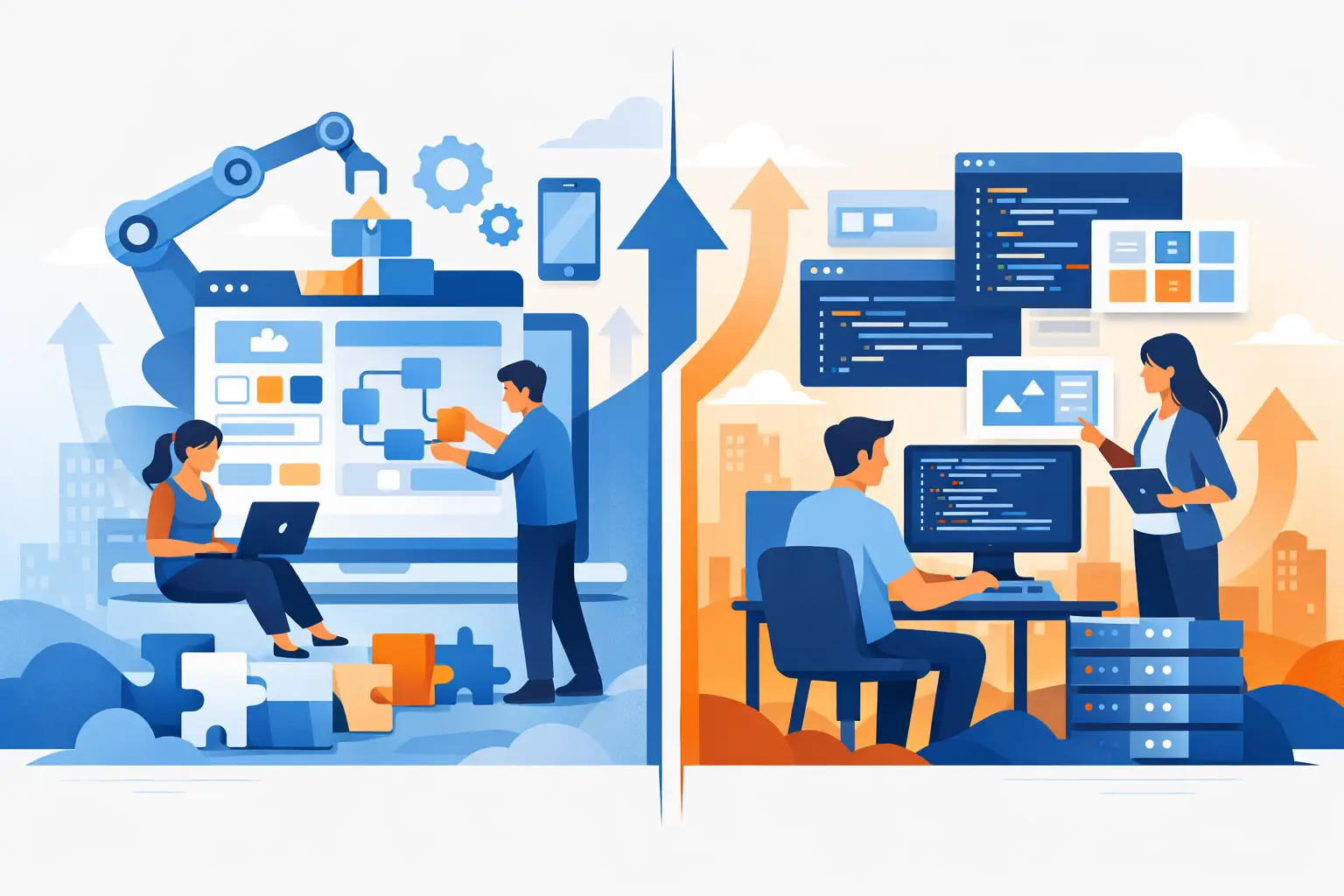
A workflow held together by spreadsheets, inbox rules, and manual handoffs is not a minor operations problem. It is often the first sign that your business needs software. The question is whether low code versus custom software will deliver the better return on the time and money you invest.
For founders and SME leaders, this is not a technical preference debate. It is a decision about speed to market, ownership of a critical process, customer experience, and the cost of changing direction six months from now. Both approaches can be right. Both can also become expensive mistakes when selected before the business problem is clear.
Low Code Versus Custom Software: Start With the Constraint
Low-code platforms let teams create applications through visual builders, prebuilt components, data connectors, and workflow automation. They can dramatically reduce the time required to launch internal tools, portals, approval flows, and straightforward customer-facing applications. The appeal is obvious: less engineering effort, faster prototypes, and a lower barrier for business teams to participate in delivery.
Custom software is designed and built specifically for your organization. It requires more upfront discovery and engineering, but it gives you control over the product experience, architecture, integrations, data model, and roadmap. It is most valuable when software itself is central to how you acquire customers, deliver your service, make decisions, or create an advantage competitors cannot easily copy.
The practical distinction is not “fast versus powerful.” A well-scoped custom build can move quickly, while a low-code project can slow down once exceptions, permissions, integrations, and platform workarounds pile up. The real question is where complexity belongs: inside a platform’s constraints or inside software you control.
When Low Code Is the Smart Business Choice
Low code works best when the process is known, the requirements are relatively stable, and the application does not need to create a differentiated market experience. Think employee onboarding, lead-routing workflows, internal request systems, basic client portals, reporting dashboards, or a first version of an operations tool.
It is particularly useful when speed matters more than polish. A growing company may need a functioning approval process next month, not a fully tailored platform after two quarters. In that case, a low-code solution can remove a bottleneck, prove adoption, and produce useful operational data before a larger investment is justified.
Low code is also a strong option for testing assumptions. If you are validating whether customers will use a self-service intake flow or whether a team can standardize a manual process, a platform-based version can answer the question without funding a complete engineering effort. The goal is not to avoid custom development forever. It is to avoid building too much before you know what deserves to be built.
That said, speed only creates value if the application is maintainable. Before choosing a platform, confirm that it supports your required integrations, data permissions, audit requirements, and expected volume. Ask who will own it after launch, how changes are tested, what happens if pricing changes, and whether you can export your data cleanly. A quick launch that creates long-term dependence on one tool can become a costly trade.
When Custom Software Earns Its Cost
Custom development makes sense when your requirements are core to the business rather than incidental to it. If your product needs a distinct user experience, complex rules, specialized AI capabilities, high-performance workflows, or deep connections with existing systems, platform limits can surface early.
Consider a services business whose margin depends on matching the right experts to the right client engagements. A generic workflow tool may handle assignments at first. But once the business needs to account for skills, availability, pricing, utilization, client preferences, capacity forecasts, and exception handling, the matching engine becomes a strategic asset. Building it as custom software may create more value than forcing those rules through a visual builder.
Custom software also gives you control over the customer experience. Customers do not judge your technology stack. They judge whether your product is clear, responsive, and useful. When the interface, onboarding flow, or service delivery model is a meaningful part of why customers choose you, tailored development gives you far more room to improve it.
The cost is not just the initial build. Custom software requires product ownership, ongoing maintenance, security updates, monitoring, and a realistic enhancement roadmap. Teams should budget for the full operating life of the product, not simply the launch milestone. This is why a strategy-led build is essential: the first release should focus on the highest-value workflow, with an architecture that can support growth without paying for features you do not need yet.
Compare the Total Cost, Not the First Invoice
Low code often appears cheaper because the first version can be delivered with fewer engineering hours. That can be true. But the total cost changes as users, data, workflows, and integrations increase. Monthly platform fees may scale with usage. Advanced capabilities may require premium plans. Custom workarounds can create maintenance issues that are difficult for nontechnical teams to diagnose.
Custom software carries a higher upfront cost because the business is funding design, engineering, quality assurance, and deployment. Yet its economics can improve over time when it replaces expensive manual work, reduces errors, supports a larger customer base, or eliminates multiple disconnected subscriptions. The right comparison is not platform cost versus developer cost. It is the cost of achieving and maintaining the business outcome.
For example, an internal tool that saves three employees five hours per week may not need a custom solution. A platform subscription and a focused configuration may be the disciplined choice. By contrast, a revenue-generating workflow that affects conversion, fulfillment, retention, or compliance deserves a deeper financial model. Quantify the revenue at risk, labor removed, decisions accelerated, and customer impact created by doing it well.
Use Flexibility as a Decision Test
Requirements always change. The question is how much they are likely to change and whether those changes are ordinary or fundamental.
Low-code platforms are flexible within their intended design. Adding a form field, updating an approval path, or creating a new dashboard can be fast. They become less flexible when the business needs a novel data model, unusual logic, sophisticated role management, or an interaction pattern the platform was not designed to support.
Custom software takes longer to modify in the earliest stages because changes must be designed, built, tested, and deployed. But a well-designed system can adapt without requiring teams to work around someone else’s product assumptions. This matters when your operating model is evolving rapidly or when the software must support multiple customer segments, geographies, or service lines over time.
A useful test is to ask: if our best-case growth plan succeeds, will this tool support the way we need to operate in 18 months? If the answer is no, low code may still be appropriate, but it should be treated as a deliberate bridge with a migration plan, not a permanent foundation by default.
The Best Answer Is Often a Hybrid Approach
Many successful products use low code and custom development together. A company might build its customer-facing platform and proprietary business logic as custom software while using low-code automation for internal notifications, CRM updates, support workflows, or administrative reporting.
This approach keeps engineering attention on the areas that create customer value and competitive advantage. It also lets operations teams improve repeatable internal processes without putting every small change into a development backlog.
The boundary should be intentional. Keep proprietary logic, sensitive data flows, and core customer journeys in systems you can govern properly. Use low code for standardized workflows where the platform’s conventions are an advantage rather than a limitation. The right architecture is not the most custom or the most automated. It is the one that gives your team the fastest path to a measurable result with manageable long-term cost.
Make the Decision With a Short Discovery Process
Before selecting a platform or commissioning a build, define the outcome in business terms. Are you trying to reduce processing time, improve conversion, launch a new service, increase retention, or give your team reliable visibility into operations? A clear outcome prevents technology from becoming the project’s purpose.
Then map the workflow at a useful level of detail. Identify the users, systems, decisions, exceptions, data sources, and handoffs involved. Pay close attention to the exceptions. The happy path is usually easy in either approach. The exceptions reveal where a low-code platform may become restrictive or where custom software may be justified.
Finally, create a phased plan. Launch the smallest version that can prove value, decide what metrics will validate the investment, and establish the point at which you will expand, rebuild, or retire the solution. At Valuedriven, this is where technical strategy and commercial judgment meet: selecting an approach based on the business case, not on a preference for a particular tool.
Choose low code when it lets you solve a real problem quickly without compromising a capability your business will depend on. Choose custom software when the product, process, or experience is central to how you grow. The disciplined move is to make the smallest investment that produces a useful learning loop, then scale the parts that are already creating value.