
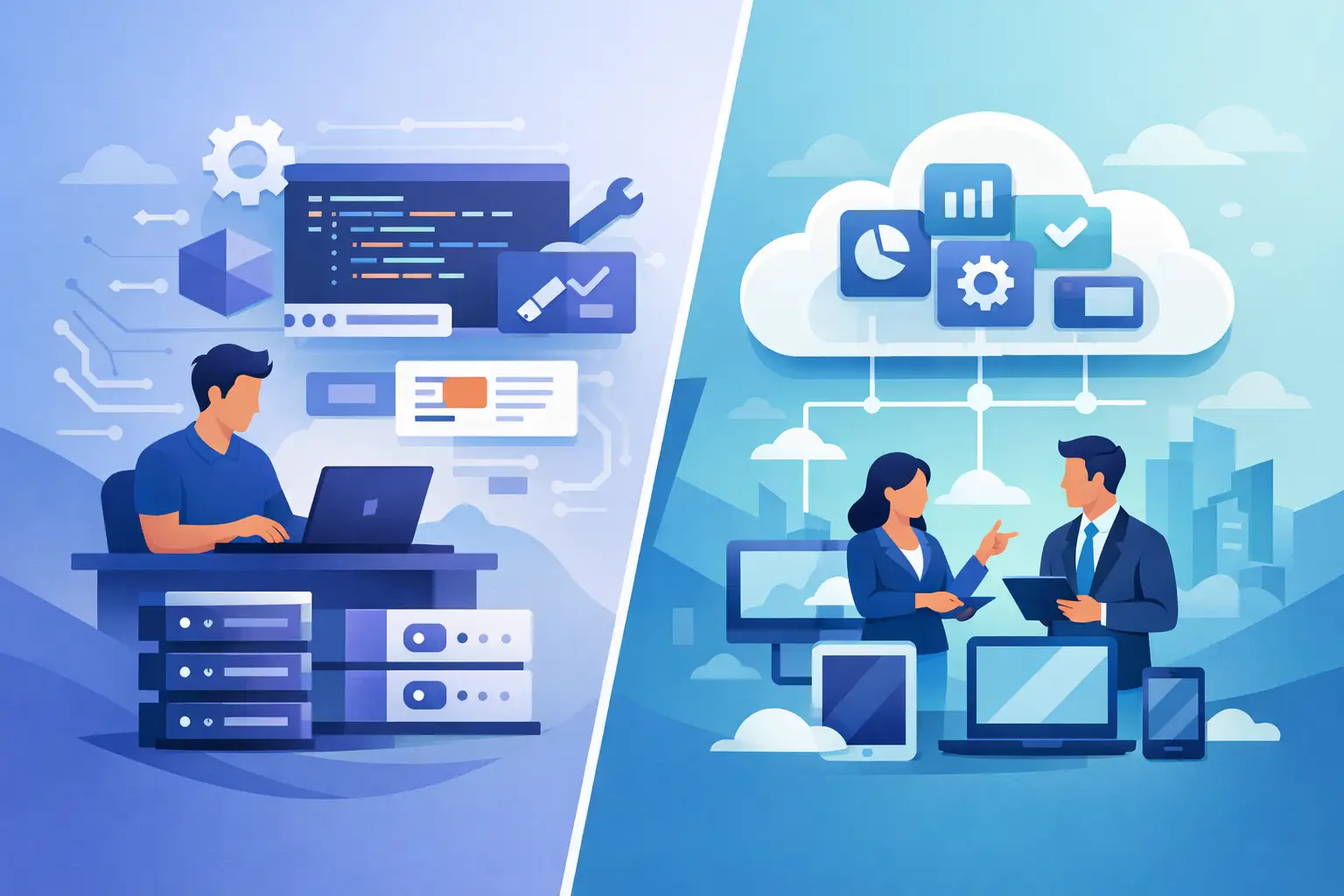
A founder sees a promising SaaS platform, schedules a demo, and hears the familiar promise: go live next week. Six months later, the team is managing workarounds, exporting data between tools, and paying for features nobody uses. The custom software vs SaaS decision is rarely about whether a tool has more features. It is about whether the technology supports the operating model your business needs to build.
For startups and growing businesses, getting this wrong can create expensive friction. A SaaS product can be the fastest path to a useful capability. Custom software can become a lasting competitive advantage. The right choice depends on the process, the economics, the level of differentiation, and how much change you expect as the company grows.
Custom Software vs SaaS Starts With the Business Problem
The most productive question is not, “Should we build or buy?” Ask instead: “Is this capability central to how we create value?”
SaaS is designed for common, repeatable business needs. Accounting, payroll, CRM, project management, recruiting, and email marketing are usually better served by proven platforms. These are mature categories with established workflows. Building your own version of a standard system often consumes capital without creating a meaningful advantage.
Custom software makes more sense when the workflow itself is differentiated. Perhaps your company has a unique quoting process, a specialized logistics model, a proprietary data set, or an AI-assisted service that customers will pay for. If your team’s workarounds are becoming the process, that is a signal that off-the-shelf software may be shaping your business in the wrong direction.
There is also a middle ground. Many businesses use SaaS platforms as a foundation and build targeted custom layers around them. A custom customer portal may pull from an existing CRM. An internal operations dashboard may unify data from several subscription tools. This approach can deliver value faster than replacing every system while preserving control where it matters most.
Where SaaS Delivers the Strongest Return
SaaS earns its place because it reduces time to value. A capable team can configure a platform, train users, and begin operating within days or weeks rather than spending months on product discovery, design, development, testing, and rollout.
The upfront cost is also easier to manage. Instead of funding a full build, you pay a recurring subscription, typically based on users, usage, or feature tiers. For an early-stage company validating a process, that flexibility is valuable. You can test demand, learn how people work, and avoid investing heavily before the requirements are clear.
SaaS providers also carry a portion of the maintenance burden. They handle infrastructure, security updates, bug fixes, and general product improvements. For businesses without an internal engineering team, this removes a significant operational responsibility.
But speed should not be confused with fit. Most SaaS products are built for a broad market, not your exact model. Configuration can address simple differences, but it has limits. Once teams rely on spreadsheets, manual approvals, duplicate data entry, or awkward integrations to bridge those gaps, the low-cost option may no longer be low cost.
SaaS pricing can also change the economics over time. Per-seat fees rise as headcount grows. Usage-based pricing rises as customer activity grows. Premium integrations, advanced reporting, and enterprise support can turn a modest monthly expense into a significant annual commitment. That does not make SaaS a poor decision. It means recurring cost needs to be evaluated against the value it produces and the constraints it creates.
When Custom Software Is Worth the Investment
Custom software is not simply software with your logo on it. It is a product designed around a specific business outcome, user journey, and operating reality. The strongest custom initiatives make a measurable difference: they reduce processing time, improve conversion, create a new revenue channel, lower service costs, or make a differentiated customer experience possible.
The investment is justified when three conditions are present. First, the problem is persistent rather than temporary. Second, the workflow is important enough that a better solution changes business performance. Third, the organization can commit to owning the product after launch, including decisions about enhancements, support, and iteration.
Ownership is a major advantage. With custom software, you control the roadmap, data model, user experience, integrations, and priorities. You are not waiting for a vendor to add a feature that may never make its roadmap. That control matters when market feedback requires fast changes or when the product experience is part of what customers choose you for.
Custom development also enables better use of AI when the opportunity is grounded in real workflows. A generic AI feature inside a SaaS platform may help with basic tasks. A purpose-built AI workflow can use your approved knowledge, business rules, customer context, and operational data to support decisions or automate high-volume work. The value comes from applying AI to a well-defined problem, not adding it because competitors are talking about it.
The trade-off is clear: custom software requires more upfront capital, more active decision-making, and more accountability. A poorly scoped build can be as frustrating as a poorly fitting SaaS platform, only more expensive. That is why strategy, requirements, and phased delivery matter as much as engineering quality.
Compare the Total Cost, Not the First Invoice
A SaaS subscription often appears cheaper because the initial payment is smaller. A custom build often appears expensive because much of the investment happens before launch. Neither view tells the full story.
For SaaS, calculate subscription fees over three to five years, expected seat or usage growth, implementation costs, integrations, training, admin time, and the labor created by workarounds. Also consider switching costs. If the platform becomes deeply embedded, moving away later can be difficult even if it stops meeting your needs.
For custom software, include product strategy, UX design, development, quality assurance, hosting, security, maintenance, and future improvements. Then evaluate the upside: revenue enabled, manual work eliminated, error reduction, retention gains, and speed of service. A custom solution does not need to replace every tool to generate strong ROI. It only needs to solve a high-value problem better than the alternatives.
This is where leadership teams often benefit from a simple business case rather than a feature comparison. Estimate what the current process costs in time, missed opportunities, delayed decisions, and customer friction. Then define what improvement would be worth. The goal is not to predict every number perfectly. It is to make the investment decision against a commercial baseline.
Use a Phased Approach to Reduce Risk
The custom software vs SaaS choice does not have to be permanent or absolute. A sensible path is often to use SaaS while the business learns, then build custom capabilities when the pattern is proven and the cost of compromise becomes visible.
For example, a services company might begin with a standard CRM and scheduling platform. As its delivery model matures, it may create a custom client workspace that automates onboarding, centralizes project visibility, and gives customers a better experience. The SaaS tools remain useful behind the scenes, while the custom layer becomes the differentiator.
For a new product, start with the smallest version that tests the highest-risk assumption. That may mean a focused MVP, a prototype with a limited user group, or an internal tool that validates the workflow before it becomes customer-facing. The point is to fund learning before funding scale.
A disciplined product partner should help define what not to build in the first release. At Valuedriven, that means connecting technical decisions to a roadmap, budget, and measurable business objective rather than treating development as a feature factory. The best early release creates evidence: users adopt it, operations improve, or customers show a willingness to pay.
A Practical Decision Framework
Choose SaaS when the capability is standard, speed is the priority, and adapting your process to the platform creates little downside. It is especially effective when you are validating an operating model, have limited technical capacity, or need reliable functionality that is not central to your differentiation.
Choose custom software when the experience, workflow, or data advantage is core to your business. It is the stronger option when existing tools create recurring manual work, prevent you from serving customers well, or limit a proven opportunity to grow revenue or reduce costs.
Consider a hybrid approach when a standard platform handles the commodity work well but cannot deliver the customer-facing or operational experience you need. This is often the highest-value path for SMEs: buy the capabilities that are already solved and build the pieces that make your business distinct.
Before committing, bring operations, product, finance, and technical stakeholders into the same conversation. The people who use the system will expose workflow realities. Finance will pressure-test the economics. Technical leadership can assess integration, data, security, and maintenance requirements. A decision made across those perspectives is less likely to be driven by a polished demo or an unrealistic build estimate.
The best technology choice is the one that gives your business room to move. Start with the smallest investment that resolves a meaningful constraint, measure the result, and expand only when the evidence supports it.