
A founder has one hard-to-replace advantage in the first year: focus. The best startup tech stack protects that advantage by helping your team ship, learn from customers, and make changes without spending every sprint managing infrastructure. It is not a shopping list of fashionable tools. It is a set of deliberate decisions tied to the product you need to validate and the business you need to build.
For most startups, the right answer is not a highly customized architecture. It is a practical foundation that moves quickly now, remains understandable as the team grows, and avoids expensive rewrites caused by poor early choices. The difference comes from selecting technology based on product risk, operating needs, and the skills you can realistically support.
Start With the Business Case, Not the Framework
A tech stack should follow your product strategy. Before choosing a front-end framework, database, or AI provider, define what the first version must prove. Is the goal to secure design partners, reduce a manual process, validate a pricing model, or demonstrate that users will return every week?
Those answers shape the build. A workflow-heavy B2B platform may need permissions, audit trails, integrations, and reliable background jobs earlier than a consumer-facing app. A marketplace may need payments, search, and trust mechanisms. An AI product may need evaluation workflows and data controls long before it needs a sophisticated design system.
This is where teams often lose time. They choose tools based on what is popular in a founder's network or what worked at a previous company, then discover that the stack does not fit the actual operating model. A better question is: what is the simplest technical approach that lets us test our most valuable assumption within the next 60 to 90 days?
What the Best Startup Tech Stack Usually Includes
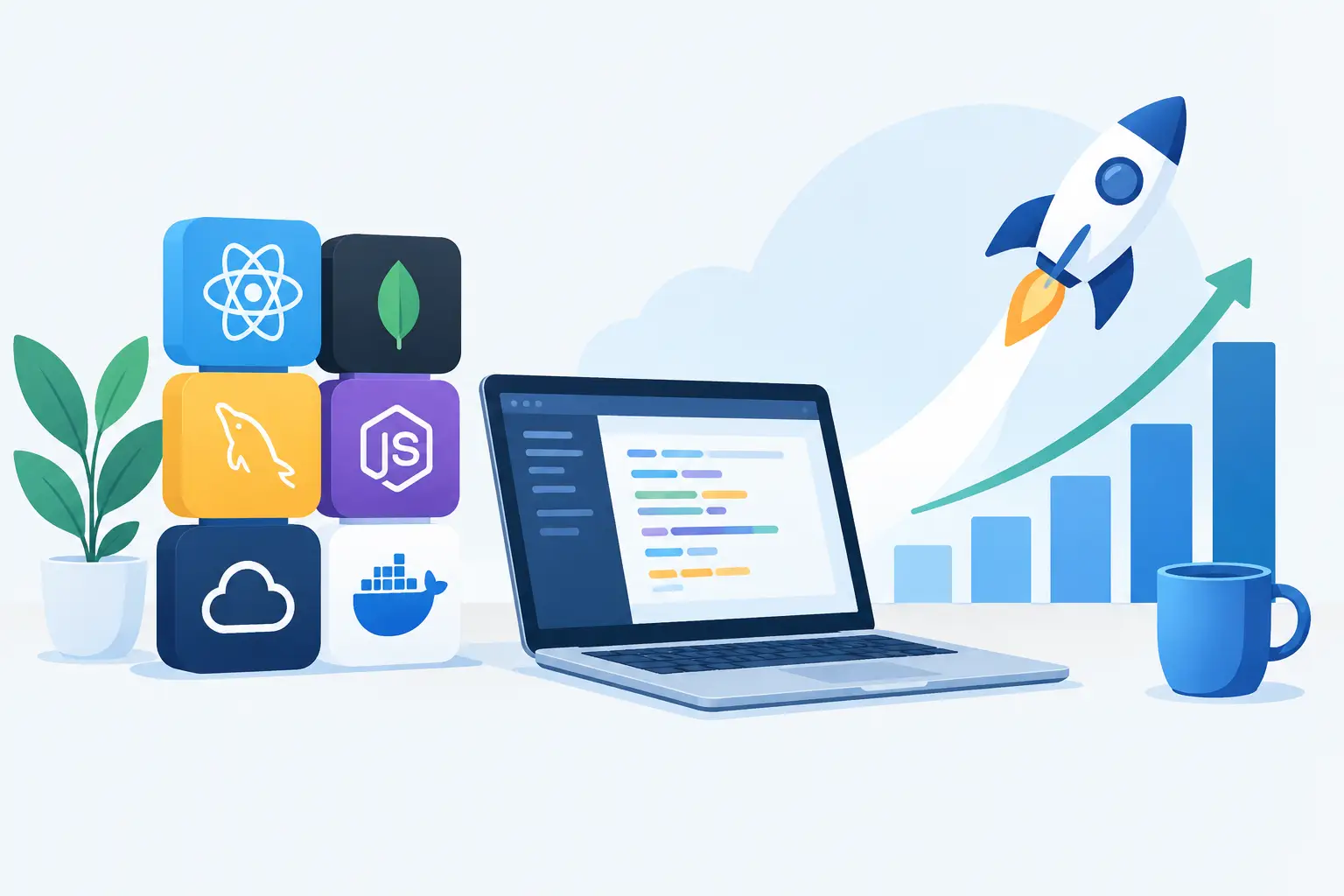
For a typical web-based SaaS product, a modern stack has five practical layers: the product interface, application logic, data storage, cloud infrastructure, and operating tools for measurement and support. The specific products can vary, but the responsibilities should be clear from day one.
Build the product interface for speed and maintainability
For many teams, React with Next.js is a sensible choice for web applications. It has a deep talent pool, mature component libraries, strong support for performance-conscious sites, and flexibility for both marketing pages and authenticated product experiences. TypeScript adds useful safeguards as the codebase and team expand.
That does not mean every startup needs Next.js. A mobile-first business may be better served by React Native or Flutter. A complex internal operations tool may benefit more from a proven low-code platform at the validation stage. The point is to choose an interface layer that supports the customer experience you need without creating a hiring or maintenance problem later.
Keep the backend boring where it matters
For the application layer, established ecosystems usually beat novelty. Node.js with a structured framework such as NestJS is a strong option for teams that want one primary language across the stack. Python with Django or FastAPI is often a good fit when the product has data science, automation, or AI-oriented needs.
Use a modular monolith for most early-stage products. It keeps deployment, testing, and development simpler while giving you room to separate services when there is a real reason to do so. Premature microservices introduce operational overhead: service communication, monitoring, deployment pipelines, access control, and harder debugging. They solve problems that most MVPs do not yet have.
Choose a database that supports the next stage
PostgreSQL is frequently the right default. It is reliable, well understood, versatile, and capable of supporting far more complexity than most early products require. It works well for transactional data, reporting, permissions, and many common SaaS workflows.
Add specialized data stores only when a measured need appears. Redis can help with caching, queues, and rate limiting. A search engine may become valuable for large catalogs or complex discovery. A vector database may have a place in an AI feature, but only after you have confirmed that retrieval materially improves the user outcome. Every added system has a cost in implementation, observability, security, and ongoing support.
Use managed cloud services strategically
Early teams should spend their engineering hours on their product, not on maintaining servers. Managed hosting and cloud services can reduce setup time and operational risk. Platforms such as Vercel can accelerate front-end deployment, while AWS, Google Cloud, or Azure provide managed databases, storage, authentication options, and background processing as requirements increase.
There is a trade-off. Platform convenience can create vendor dependence, and costs can rise with usage. That is manageable when the decision is intentional. Establish basic cost monitoring early, document your cloud choices, and avoid building around proprietary features unless they provide a clear delivery advantage.
Do Not Treat AI as a Separate Tech Stack
For AI-native products, the model is only one layer of the system. The commercial value comes from the workflow around it: the data you use, the prompts or instructions, the user experience, the safeguards, and the way quality is measured over time.
Start with an API-based model provider when speed matters. This avoids the expense and complexity of hosting models before there is evidence that self-hosting is justified. Build a small evaluation set from realistic customer scenarios, track accuracy and failure patterns, and give users a way to correct or override results. For sensitive use cases, determine where data is processed, retained, and logged before launch.
AI features need product discipline. If an assistant saves a recruiter ten minutes per job description but produces unreliable recommendations, the time saved may disappear in review work. If a summarization feature handles 80% of routine cases accurately, it may still be valuable when the remaining 20% are clearly flagged for human judgment. Define success in operational terms, not model-demo terms.
The Operating Tools That Prevent Expensive Surprises
A startup stack is incomplete without visibility into what customers and systems are doing. Product analytics, error tracking, logging, customer support, and basic security controls should arrive much earlier than many teams expect. They are not enterprise extras. They help a lean team find conversion drop-offs, diagnose incidents, and prioritize work with evidence.
At a minimum, establish a source control workflow, automated testing for critical paths, a deployment pipeline, error monitoring, backups, and role-based access. Add analytics that answer product questions rather than collecting every possible event. You should be able to see where users abandon onboarding, which features lead to retention, and whether releases improve the experience.
Security deserves the same practical approach. Do not overengineer compliance before it is required, but do protect customer data from the start. Use secure authentication, encrypt sensitive data, limit production access, manage secrets properly, and create a process for responding to vulnerabilities. Retrofitting basic security after a customer request or incident is far more disruptive.
A Practical Decision Framework for Founders
When evaluating tools, score each option against four criteria: time to launch, total cost of ownership, team capability, and ability to support the next business milestone. A tool that is technically impressive but difficult to hire for may be the wrong decision. A low-code tool that gets a pilot live in three weeks may be exactly right, even if it will eventually need replacement.
The best decisions also have an exit path. If you choose a managed authentication provider, understand how user data can be migrated. If you use a no-code workflow for internal operations, know what would trigger a move to custom software. If a vendor owns a critical capability, avoid coupling unrelated parts of the product to that vendor.
Document these choices in a short technical roadmap. It should identify what you are building now, what you are deliberately postponing, the risks that need monitoring, and the decision points that would justify further investment. This makes technology a managed business asset rather than a collection of one-off engineering decisions.
Build for Learning, Then Scale With Evidence
The best startup tech stack is not the one that looks most sophisticated in an architecture diagram. It is the one that helps your team deliver a credible product on time, learn from real users, and invest in scale only where the market has earned it.
A strategy-led technical partner can help founders make those trade-offs without slowing delivery. At Valuedriven, that means aligning the roadmap, product scope, and engineering choices with the commercial result the business needs next.
Choose technology that keeps your options open, gives your team clear operating habits, and makes the next customer conversation more informed than the last. That is how an MVP becomes a product with a durable path to growth.