
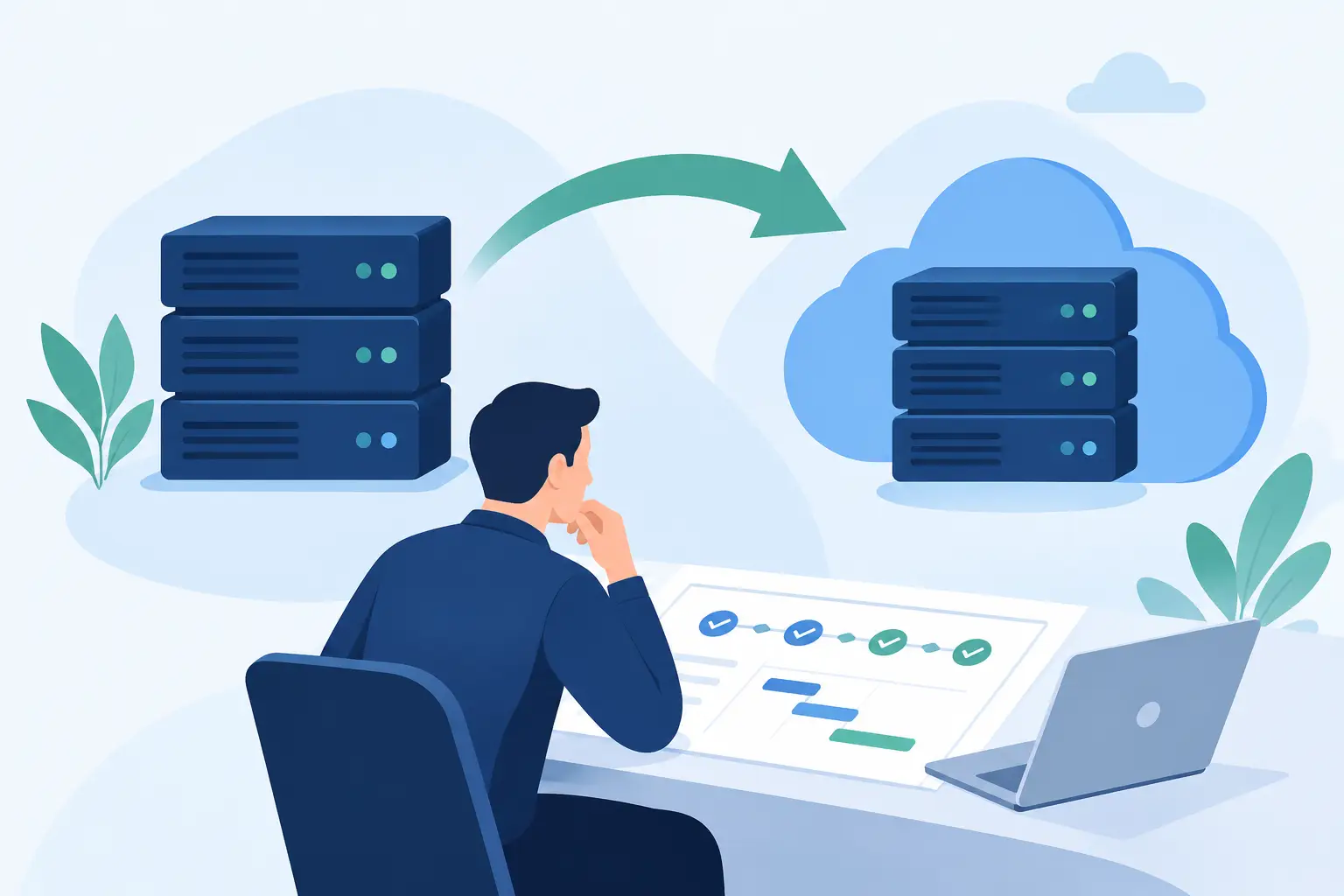
A platform migration is rarely just a technical replacement. It can affect how customers buy, how teams operate, how data moves, and how quickly the business can respond to change. A guide to platform migration planning should therefore start with commercial priorities, not a feature checklist. The strongest migrations protect current revenue while creating a more capable foundation for growth.
For founders and SME leaders, the risk is not simply choosing the wrong platform. It is spending months and significant budget moving an existing problem to a new environment. A disciplined plan creates clarity before delivery begins: what must improve, what must remain stable, what can be retired, and how success will be measured.
Start with the business case, not the platform
Teams often begin by comparing vendors or debating architecture. Those decisions matter, but they are downstream of a more useful question: what is the current platform preventing the business from doing?
The answer may be slow checkout performance, costly manual operations, unreliable reporting, an inability to launch new products, security exposure, or an internal team that cannot maintain the system confidently. Each problem leads to different priorities. A commerce migration focused on conversion needs a different plan than an operational platform replacement focused on reducing fulfillment errors.
Write a short migration charter that names the business outcome, the affected users, the budget range, the decision owner, and the deadline that actually matters. A vague objective such as modernize our platform invites scope growth. A specific objective such as reduce order-processing time from two days to four hours gives the team a practical way to make trade-offs.
Define a small set of success measures before design starts. Revenue teams may track conversion, retention, average order value, and support volume. Operations teams may care more about processing time, error rates, adoption, and cost per transaction. Technical measures such as page speed, uptime, and deployment frequency are valuable, but they should support the business case rather than replace it.
Build an honest picture of the current state
Migration plans fail when teams underestimate the platform they already have. The visible application is only one part of the system. Business logic may be hidden in spreadsheets, customer support workflows, scheduled scripts, third-party integrations, and employee workarounds that no one formally owns.
Start with discovery. Document the core user journeys, data sources, integrations, reporting dependencies, security requirements, and manual processes. Speak with the people who use and support the platform every day, not only the executives who commissioned the project. An operations manager may know why a field must be retained. A support lead may identify the edge case that causes the most customer friction.
This is also the point to separate required functionality from inherited complexity. Every migration is an opportunity to retire unused features, duplicate data, outdated permissions, and brittle processes. Moving all legacy behavior because it exists is expensive and usually counterproductive.
Map risk by business impact
Not every component deserves the same level of migration effort. Classify systems and workflows by their impact if they fail, their data sensitivity, and how difficult they are to restore. Payment processing, customer identity, regulatory records, and high-volume transactional workflows typically require deeper testing and clear rollback procedures.
A simple risk register is often enough. For each significant risk, identify an owner, a mitigation, a trigger, and a response. For example, if customer records may not match after transfer, define the reconciliation checks, the acceptable error threshold, and the process for resolving exceptions before launch. Assigning ownership early avoids the common problem of discovering critical decisions during a release weekend.
Choose a migration approach that fits the constraints
There is no universally correct migration method. The right approach depends on the platform's complexity, business tolerance for change, team capacity, and the urgency of the outcome.
A full replacement can make sense when the current system is hard to maintain, limits growth, or carries unacceptable security and reliability risk. It offers a cleaner long-term result, but it also concentrates cost and delivery risk. A phased migration reduces operational disruption by moving functions in stages, though it may require temporary integrations and parallel support for old and new systems.
A strangler approach is useful when a critical legacy platform cannot be switched off at once. New capabilities are built around it, and legacy functions are gradually replaced as value is proven. This can protect continuity, but leaders should budget for the added complexity of running two environments during the transition.
The goal is not to choose the most technically elegant model. It is to select the path that reaches the business outcome with acceptable risk, cost, and speed. For a growing company, a focused first release that removes the largest bottleneck can be more valuable than a year-long transformation program.
Create a target-state blueprint before building
Once the approach is clear, define what the future platform needs to do and how it will operate. This is more than a technical architecture diagram. It should show how users access the system, where key data lives, how systems exchange information, who owns each capability, and what happens when a dependency fails.
Keep the blueprint decision-oriented. Confirm which capabilities will be built, configured, bought, or removed. Establish standards for identity and access, data retention, monitoring, backups, and integration ownership. If AI features are part of the target state, specify the business workflow they improve, the human review point, the data boundaries, and how quality will be measured. Adding AI without a defined operating model creates another system to supervise rather than a measurable advantage.
Scope discipline matters here. Categorize work as required for launch, required shortly after launch, or valuable but deferrable. The distinction protects budget and creates a release plan that teams can execute with confidence.
Treat data migration as a product workstream
Data is often the biggest source of hidden migration risk. Customer histories, product records, permissions, documents, analytics events, and financial data rarely share the same structure or quality standards across systems. A successful transfer requires more than exporting and importing records.
Define data ownership and decide what will be migrated, archived, transformed, or deleted. Clean data before it enters the new platform. Standardize formats, remove duplicates, resolve incomplete records where possible, and preserve audit requirements. If the old system contains years of low-value data, retaining all of it may increase cost and make the new platform harder to use.
Run at least one rehearsal migration using representative data. Validate record counts, relationships, permissions, and business-critical reports. Then ask operational users to complete real tasks in the new environment. Technical validation confirms that data arrived. User validation confirms that it remains useful.
Plan integrations and operational readiness together
Many launches succeed in a test environment and struggle in production because integrations and people were treated as afterthoughts. Inventory every external dependency, including payment providers, CRM tools, analytics, email platforms, warehouses, accounting systems, and identity services. For each one, clarify data direction, failure behavior, rate limits, support contacts, and monitoring needs.
Operational readiness deserves the same attention. Update support documentation, train internal users, establish incident routes, and define who can make launch-day decisions. If workflows change, communicate the reason as well as the new process. Adoption is stronger when employees understand how the migration reduces friction or improves customer outcomes.
Test the business, not only the software
Testing should reflect the real ways customers and employees use the platform. Unit and integration tests are necessary, but they do not replace end-to-end scenarios such as a customer placing an order, a team member correcting an address, a refund being issued, and the transaction appearing correctly in reporting.
Test performance under realistic demand, permissions across user roles, error handling, and recovery paths. Include accessibility and security testing where relevant to the product and audience. Most importantly, define launch criteria in advance. A launch should not depend on a subjective sense that the platform looks ready.
For high-risk migrations, use a controlled rollout. Release to a subset of users, a limited region, or one business unit first. Monitor the agreed measures, collect feedback quickly, and expand when the evidence supports it. A phased launch may take slightly longer, but it can prevent a single avoidable incident from damaging customer trust.
Make cutover and rollback decisions explicit
The final transition needs a detailed runbook with timing, owners, dependencies, validation checks, communications, and escalation paths. Everyone involved should know what happens if a data check fails, an integration becomes unavailable, or performance drops below an agreed threshold.
A rollback plan is not a sign of weak confidence. It is disciplined risk management. Define the conditions that trigger it, how data changes will be handled, who has authority to make the call, and how customers and employees will be informed. The best time to resolve these questions is before the launch window begins.
Keep improving after launch
Migration is complete only when the business can operate effectively on the new platform. Track the success measures from the original charter for several weeks after release. Compare expected improvements with actual results, resolve recurring issues, and use the findings to prioritize the next increment of work.
This is where a strategy-led delivery partner can add real value. At Valuedriven, the focus is not simply on moving systems. It is on making the migration support clearer operations, better customer experiences, and a platform that can grow without recreating the constraints it replaced.
A well-planned migration gives a business more than newer technology. It gives leaders a clearer operating model and a practical base for the next decision that matters.