
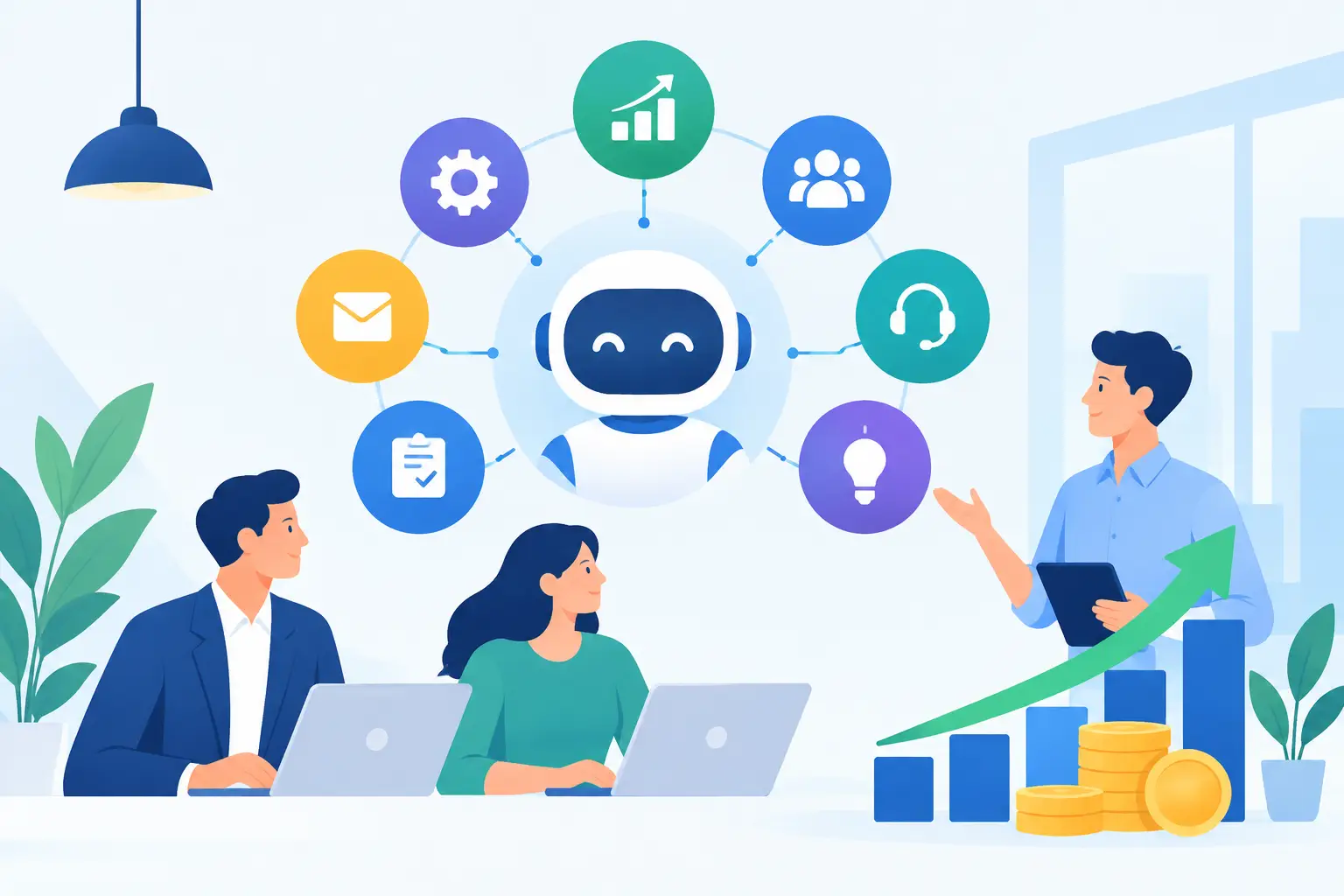
A 12-person operations team should not need to spend Monday morning manually sorting customer emails, reconciling spreadsheets, and chasing project updates. Yet that is still the reality in many growing businesses. The best AI use cases SMEs are not flashy experiments. They remove recurring friction from workflows where time, revenue, or customer experience is already being lost.
For founders and business leaders, the question is not whether artificial intelligence can help. It is whether a specific implementation can produce a measurable result without creating a costly toolset, security risk, or process disruption. The most effective AI initiatives start with a narrow business problem, clear ownership, and a practical path from pilot to daily use.
What Makes an AI Use Case Worth Funding?
AI is most valuable when it improves a process that is frequent, expensive, slow, or difficult to scale with headcount. A workflow that happens once a quarter may not justify a custom solution. A workflow performed hundreds of times each month, where errors affect customers or margins, is a stronger candidate.
Before selecting a tool or commissioning a build, define the baseline. How long does the process take today? What does it cost in labor, delayed decisions, lost leads, or rework? What level of accuracy is acceptable? A realistic AI business case connects the answer to an operational metric, not a vague expectation of productivity.
It also depends on the quality and accessibility of your data. An AI assistant cannot reliably answer customer questions if product documentation is outdated. A forecasting model will not create useful insight from inconsistent sales records. In many SMEs, the highest-return first step is organizing the data and workflow around the use case rather than pursuing a complex model.
10 Best AI Use Cases for SMEs
1. Customer support triage and response assistance
Support teams often lose time locating information, categorizing requests, and drafting repetitive replies. AI can classify incoming tickets, route them to the right person, suggest responses based on approved knowledge, and surface relevant order or account context.
This is different from fully replacing support with a chatbot. For a growing business, a human-reviewed assistant is often the better first move. It reduces response times while keeping judgment, escalation, and brand voice under team control. Measure first-response time, resolution time, ticket backlog, and customer satisfaction.
2. Sales lead qualification and follow-up
Leads frequently go cold because no one has the capacity to research every inquiry, identify buying signals, and send timely follow-ups. AI can enrich lead records, summarize calls, draft personalized outreach, and rank opportunities based on criteria your sales team already uses.
The key is to avoid treating a score as fact. Sales leaders should define what a qualified lead means, review early recommendations, and monitor conversion quality. The goal is not more automated messages. It is faster attention for the prospects most likely to become valuable customers.
3. Internal knowledge assistants
When employees repeatedly ask where to find a policy, proposal template, pricing rule, onboarding guide, or technical specification, valuable time disappears into search and interruption. A secure internal AI assistant can retrieve answers from selected company documents and cite the source material for review.
This use case is particularly useful for businesses with distributed teams, rapid hiring, or technical services that depend on specialized knowledge. It requires thoughtful permissions and document governance. Not every file should be available to every employee, and outdated documentation must be identified rather than amplified.
4. Document processing and data extraction
Invoices, contracts, purchase orders, applications, compliance forms, and supplier documents are common sources of manual work. AI can extract fields, flag missing information, classify documents, and pass structured data into finance, CRM, or operations systems.
The return can be significant because document work is repetitive and easy to measure. Start with one document type that has enough volume to matter. Build in exception handling from day one, since edge cases and low-quality scans will always require a person to review them.
5. Financial forecasting and cash-flow visibility
For many SMEs, cash flow is a more urgent concern than top-line growth. AI can help identify payment patterns, forecast near-term revenue and expenses, flag unusual movements, and model scenarios such as delayed receivables or changes in hiring plans.
These tools should support finance judgment, not replace it. Forecasts are only as reliable as the underlying data and assumptions. A practical implementation combines historical records with inputs leaders can understand and challenge, producing a clearer view of risk before it becomes a crisis.
6. Marketing content operations
Marketing teams can use AI to turn a webinar, customer interview, product update, or sales call into first drafts for emails, social posts, landing page copy, and campaign briefs. It can also help organize themes from customer feedback and identify questions that should be addressed in content.
The trade-off is quality control. Generic AI-generated content can dilute a differentiated brand quickly. Use AI for research, repurposing, structured drafts, and production speed, while keeping message strategy, subject-matter expertise, and final editorial decisions with people who understand the business.
7. Personalized website and product experiences
A website that shows the same content to every visitor misses opportunities to guide users based on their needs. AI can support smarter search, recommendations, tailored onboarding, and content personalization based on behavior, account type, or stated goals.
This use case is strongest when there is enough traffic or product activity to learn from. For lower-volume businesses, rule-based personalization may be more cost-effective at first. The right solution depends on whether the added relevance improves conversion, activation, retention, or average order value enough to justify the work.
8. Operations planning and demand prediction
Businesses managing inventory, scheduling, delivery capacity, field teams, or production can use AI to identify demand patterns and recommend more informed planning decisions. This can reduce stockouts, excess inventory, overtime, and avoidable delays.
Operational AI needs close collaboration between the people building it and the people doing the work. A technically sound model will fail if it ignores supplier constraints, local knowledge, seasonal events, or the realities of fulfillment. Test recommendations against real operating conditions before automating decisions.
9. Recruiting and employee onboarding support
AI can reduce administrative burden in hiring by summarizing applications, organizing interview feedback, drafting role-specific outreach, and answering routine onboarding questions. It can also help managers create first-week plans and training materials tailored to a role.
This is an area where governance matters. Hiring decisions carry legal, ethical, and reputational risk. AI should assist with administration and structured evaluation, not make opaque decisions about people. Maintain human oversight, consistent criteria, and a clear record of how candidates are assessed.
10. Product analytics and customer insight
Customer interviews, support tickets, reviews, survey responses, and product behavior generate useful signals that smaller teams rarely have time to synthesize. AI can cluster recurring themes, summarize feedback, detect sentiment shifts, and highlight friction points in a product journey.
This helps product leaders move beyond the loudest individual request. Used well, it informs roadmap decisions with a fuller view of customer needs. Used poorly, it can create false confidence from incomplete data. Combine AI-generated patterns with direct customer conversations and commercial priorities.
How to Prioritize an AI Initiative
A long list of opportunities is not a roadmap. Select one initiative by comparing business impact, implementation effort, data readiness, adoption risk, and time to value. A support assistant that saves 20 hours a week may be a better investment than a sophisticated recommendation engine that requires six months of data integration.
A focused pilot should have a defined user group, a limited workflow, and success measures agreed upon before development begins. For example, a document-processing pilot might target one invoice format and aim to reduce manual entry time by 60 percent while maintaining an agreed accuracy threshold. That creates a decision point: expand, refine, or stop.
Avoid buying disconnected AI tools for every department. Tool sprawl creates duplicate data, unclear ownership, inconsistent security practices, and subscriptions that rarely get used. In many cases, integrating AI into systems your team already relies on delivers better adoption than introducing another standalone dashboard.
Build for Trust, Not Just Automation
The fastest implementation is not always the best one. Customer-facing responses, financial recommendations, and employee-related workflows need guardrails. Define what the AI can do independently, what requires approval, what data it can access, and how errors are reported and corrected.
Security and privacy should be part of the initial design, especially when customer, financial, or employee data is involved. Leaders should know where information is stored, whether it is used to train external models, who can access it, and how permissions are managed. These decisions are easier and less expensive to make before a pilot becomes embedded in daily work.
For SMEs, the advantage is not having the biggest AI budget. It is the ability to make decisions quickly, test a focused idea, and adjust without enterprise-scale bureaucracy. Start where the pain is visible and the outcome is measurable. A strategy-led partner such as Valuedriven can help translate that opportunity into an implementation plan that fits the business, the budget, and the team that must use it.